At Kassia Academy, assessment is an integral part of teaching and learning. Its purpose is to help us understand what learners know, remember and can do, identify gaps or misconceptions, and determine what needs to happen next.
We use a range of assessment information to build a rounded picture of each learner. This includes information available when a learner joins us, ongoing teacher assessment, classroom and curriculum-based assessment, more formal assessment points and other relevant information about their previous learning and educational experience.
Every learner arrives at Kassia with a different starting point. Their previous educational experiences, prior attainment, attendance, additional needs and the amount of curriculum they have previously accessed can all be different.
For this reason, we do not rely on one assessment score or one source of information when setting expectations.
We use Kings Levels to help establish where a learner is currently working and to support the setting of appropriate internal targets. Progress towards these targets is then described as:
AT – Above Target
OT – On Target
NT – Near Target
BT – Below Target
These judgements are informed by a range of evidence and are not based on a single test or piece of work.
Each learner has an Individual Assessment Passport which helps us bring together the different information we hold about their learning and starting point.
The passport allows staff to consider the learner as an individual, including their prior learning and educational experience, rather than making assumptions based on age or year group alone. This is particularly important for learners who may have experienced disrupted education, periods of low attendance or several previous settings.
This information helps us set meaningful and appropriately ambitious targets, identify gaps in foundational knowledge and monitor progress from each learner's actual starting point.
Assessment happens continually in lessons. Teachers use questioning, discussion, observation, written and practical work and learners' responses to check understanding and identify misconceptions.
Assessment information is used to inform the next stage of teaching. This may mean providing further explanation, additional practice or support, revisiting previous learning or increasing challenge when a learner is secure.
Alongside this ongoing assessment, Kassia has three formal assessment and data capture points each year: Autumn, Spring and Summer. These provide opportunities to review progress over time and consider whether learners are making appropriate progress towards their individual targets.
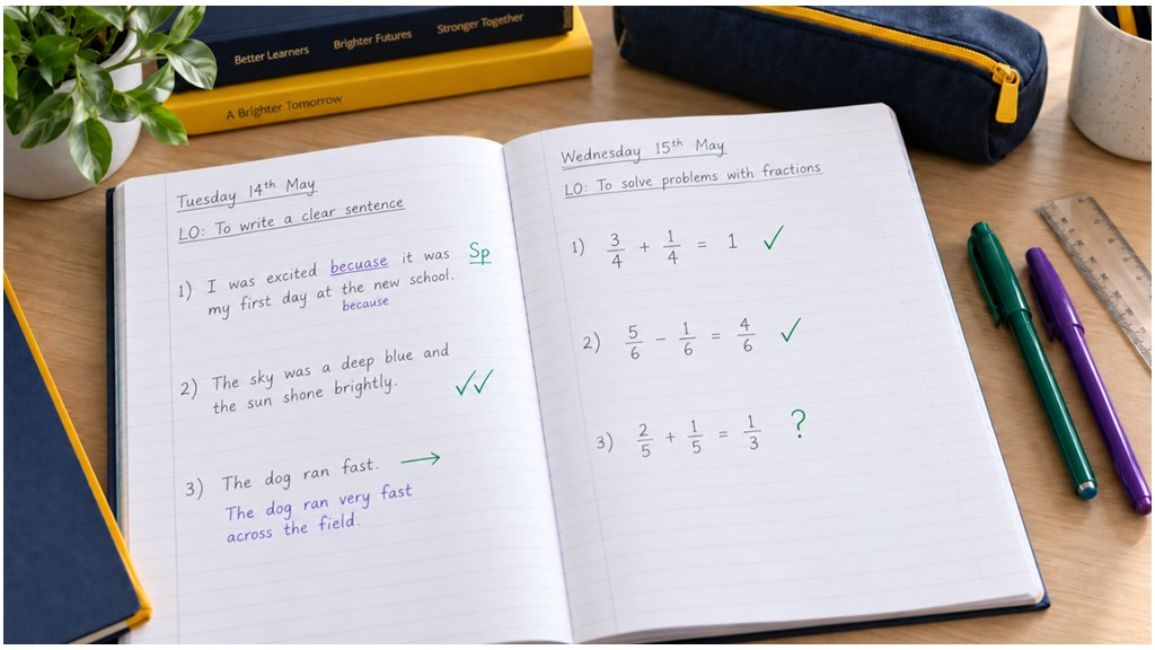
Feedback is an important part of assessment, but effective feedback does not depend upon the amount of written marking in a learner's book. At Kassia, staff use professional judgement to choose the form of feedback most likely to improve learning.
Feedback may be immediate during teaching, provided towards the end of a lesson or sequence, or arise from teachers reviewing work and assessment information afterwards. It may include verbal feedback, questioning, live marking, modelling, re-teaching, additional practice, pupil correction or written feedback.
The key principle is that feedback should lead to action. This may involve a learner correcting an error, improving part of their work, explaining their reasoning, practising an identified skill or revisiting important previous learning.
Our approach is deliberately specific, proportionate and manageable. The effectiveness of feedback is judged by its impact on learning rather than by the quantity of teacher writing in books.
Learners' progress is reviewed formally during the academic year and shared with parents and carers through the school's agreed reporting arrangements and Progress Review Days.
These discussions enable us to consider progress, achievements, areas for further development and the next steps in each learner's education.